Artificial Intelligence has stepped over the bar of merely being a future trend; it has become a major skill in the workplace. By the end of 2026, AI tools will be commonly used, understood, and even collaborated on by professionals throughout different sectors in their day-to-day activities.
AI is transforming the whole business process from the execution of routine tasks to making more robust decisions.
This blog helps you understand why the acquisition of AI skills for professionals is not a choice anymore, but rather a necessity for career development and success in the long run.
Key Reasons AI Skills Are Now Crucial:
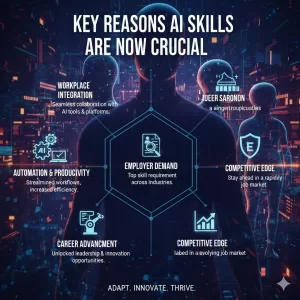
- Workplace Integration: AI skills for professionals are no longer a thing for the far future; it is evolving into everyday technology by supporting various applications, from recommendation engines to healthcare diagnostics. Therefore, all professionals, in any career, must learn how to utilize AI.
- Automation & Productivity: Artificial Intelligence automates repetitive jobs, allowing employees to focus on higher-level tasks. However, companies require trained professionals to design the automation workflows, as well as to manage the tools used to operate them.
- Employer Demand: According to Gartner, over 80% of large enterprises will have adopted Generative AI by 2026, therefore, many companies have begun relying on practical skill sets such as prompt engineering, data analysis, and AI tool integration when hiring new employees rather than traditional educational credentials.
- Career Advancement: AI skills for professionals will provide opportunities for accelerated advancements and salary growth; data from LinkedIn and GSDC indicate a growing disparity between individuals with AI skills and those without.
- Competitive Edge: Acquiring skills related to AI technologies keeps you valuable and, therefore relevant; it allows you to leverage AI to increase your performance rather than being replaced by it.
Essential Skills for 2026:
Prompt Engineering: Being able to interact properly with AI such that one can obtain the desired results.
Data Literacy: Being able to read, analyze, and draw conclusions from the data produced by AI, which will serve as a basis for business decisions.
Workflow Automation: Creating procedures that are manageable by AI in an effective manner.
Ethical AI: Making certain that the application of AI is fair and responsible.
Critical Thinking: Weighing the AI outputs, which can, at times, be erroneous.
How Are Job Roles Evolving Because of AI?
- AI is not replacing job roles but rather modifying job responsibilities.
- Many roles today require a mix of domain knowledge and knowledge of AI.
- Marketers use AI to analyze and optimize marketing campaigns.
- Finance professionals utilize AI to forecast future outcomes and detect fraud.
- Human Resources teams utilize AI to screen resumes and engage employees.
- AI skills for professionals increase their value rather than compete with automation.
Job roles are giving preference to those professionals who are able to combine the strengths of human expertise and AI-driven capability.
What Are the Factors That Make Decision-Making More AI-Driven?
- Data is the lifeblood of companies, and artificial intelligence is the method that processes large and complex data sets at a rapid speed and without errors.
- AI skills for professionals pave the way to find new patterns and trends, as well as to forecast accurate and timely insights that contribute to better decisions.
- Nevertheless, human judgment is still the crucial factor to provide the correct interpretation of the AI outputs.
- In the year 2026, understanding the limitations, biases, and accuracy of AI will be one of the most critical professional skills.
- In this regard, it is up to the professionals to make responsible decisions by taking into account both AI insights and human judgment.
FAQ’s
- Why are AI skills for professionals important in 2026?
In 2026, AI skills help professionals work more effectively by improving decision-making and remaining relevant as AI continues to become part of day-to-day business operations.
- Do non-technical professionals also need AI skills?
Yes, every professional in any non-technical field, including marketing, finance, human resources, education, healthcare, etc., should possess basic knowledge of AI (AI literacy).
- What level of AI knowledge is required of a professional?
A professional does not have to code, but must understand how AI tools operate, how to utilize AI tools, and how to measure the performance of AI outputs.
- Can professionals with AI skills advance in their careers?
Yes, AI-skilled employees are generally better suited for productivity and adaptability, increasing their desirability to potential employers, resulting in retention and increasing job and promotion opportunities.
- How can professionals begin the process of learning AI?
A professional can start by taking an online course, practicing on a hands-on basis with AI tools, participating in workshops and investigating examples of real-world use in their particular industry.
Learn Smart, Adapt Faster, Thrive with AI
AI has moved from being a future advantage to becoming a necessity in the present for every professional. The continuous development of workplaces leads to the fact that those who possess AI skills will be the ones who remain relevant, productive, and competitive in their careers. With BigDataTrunk you get to master AI at your own pace, get certified by the industry, and practice your new skills without fear. Start your AI learning path with Big Data Trunk today and ensure you are job and future ready for 2026.