
Enterprises are not just automating their traditional processes but moving towards systems that can actually think for themselves, perform the necessary actions, and learn from the experience. This is where Agentic AI comes into focus, enabling agentic AI applications to operate with goal-oriented autonomy rather than fixed rules
This blog explains what Agentic AI is? why it matters, and how it is applied in modern enterprises. Even in decision-making, Agentic AI is paving the way for smarter processes, which in turn is revolutionizing the foundation of how organizations behave.
What is Agentic AI?

Agentic AI describes a category of artificial intelligence that is capable of acting as an independent agent. In contrast to general AI that only executes requests, the systems that are agentic can pave their path, monitor the results, and modify their behavior according to the situation.
Key Ways Agentic AI Is Transforming Enterprises
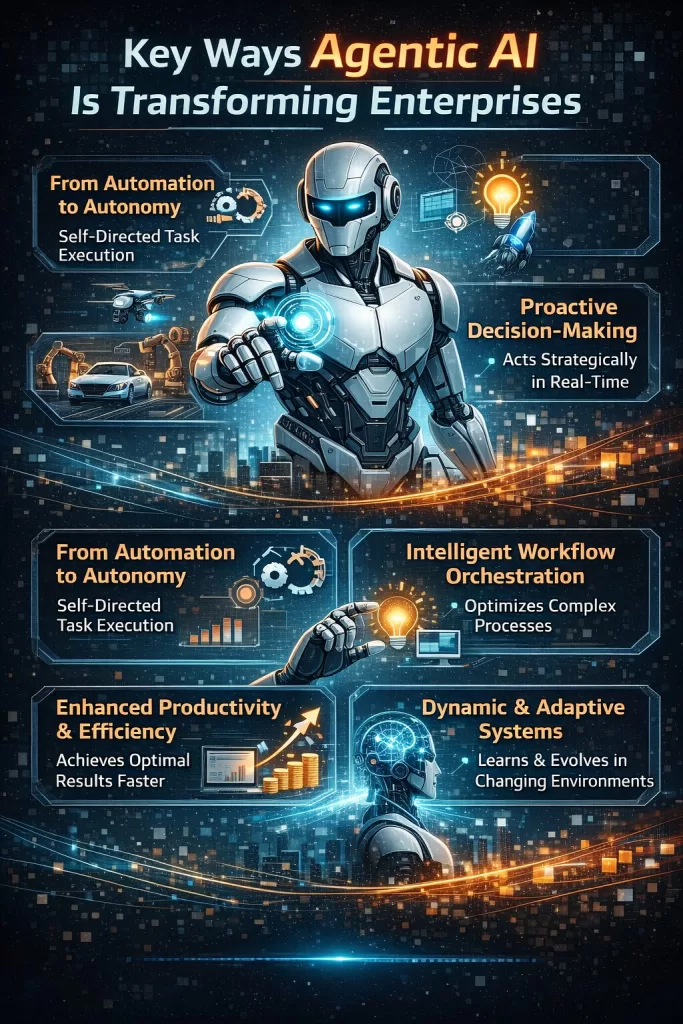
From Automation to Autonomy: The movement is quite radical as it leads from simple automation through to the ability of agents to set their own objectives, carry out the planning, use the necessary tools, and execute complicated procedures entirely by themselves while also being able to change their ways in accordance with the prevailing situation.
Proactive Decision-Making: The newly developed system replaces the slow, and hence inefficient, reactive dashboards with quick, but very effective systems through which live data is handled in real-time allowing instant adjustments. Agentic AI applications are helping companies achieve smarter automation and more informed decision-making at scale.
Intelligent Workflow Orchestration: Agents take control of complex, interdepartmental workflows, utilizing data across platforms and APIs to streamline operations from IT incident response to claims processing.
Enhanced Productivity & Efficiency: The system liberates human resources by primarily automating the less interesting and low-skilled tasks, which, in turn, leads to fewer manual operations and thus lower costs, allowing people to do more interesting and valuable work.
Dynamic & Adaptive Systems: Static software environments are thus transformed into ones that are dynamic, learning, and adaptive. For instance, the CRM is converted into an intelligent customer service agent, and the SaaS into an autonomous system.
The integration of agentic AI applications enables enterprises to optimize processes and unlock new growth opportunities.
Real-World Applications:
Finance: Fraud detection in real time, lending process fully automated, and constant compliance checks.
Supply Chain: Risk management done beforehand, procurement that adapts to the changes, and optimization of delivery routes.
Customer Service: Getting over in-house escalations of complicated issues by pulling information from CRM and knowledge bases.
IT Operations: Given monitoring, diagnosis, and self-remedy of infrastructure issues.
Agentic AI applications are helping companies achieve smarter automation and more informed decision-making at scale
How Enterprises Are Adopting It:
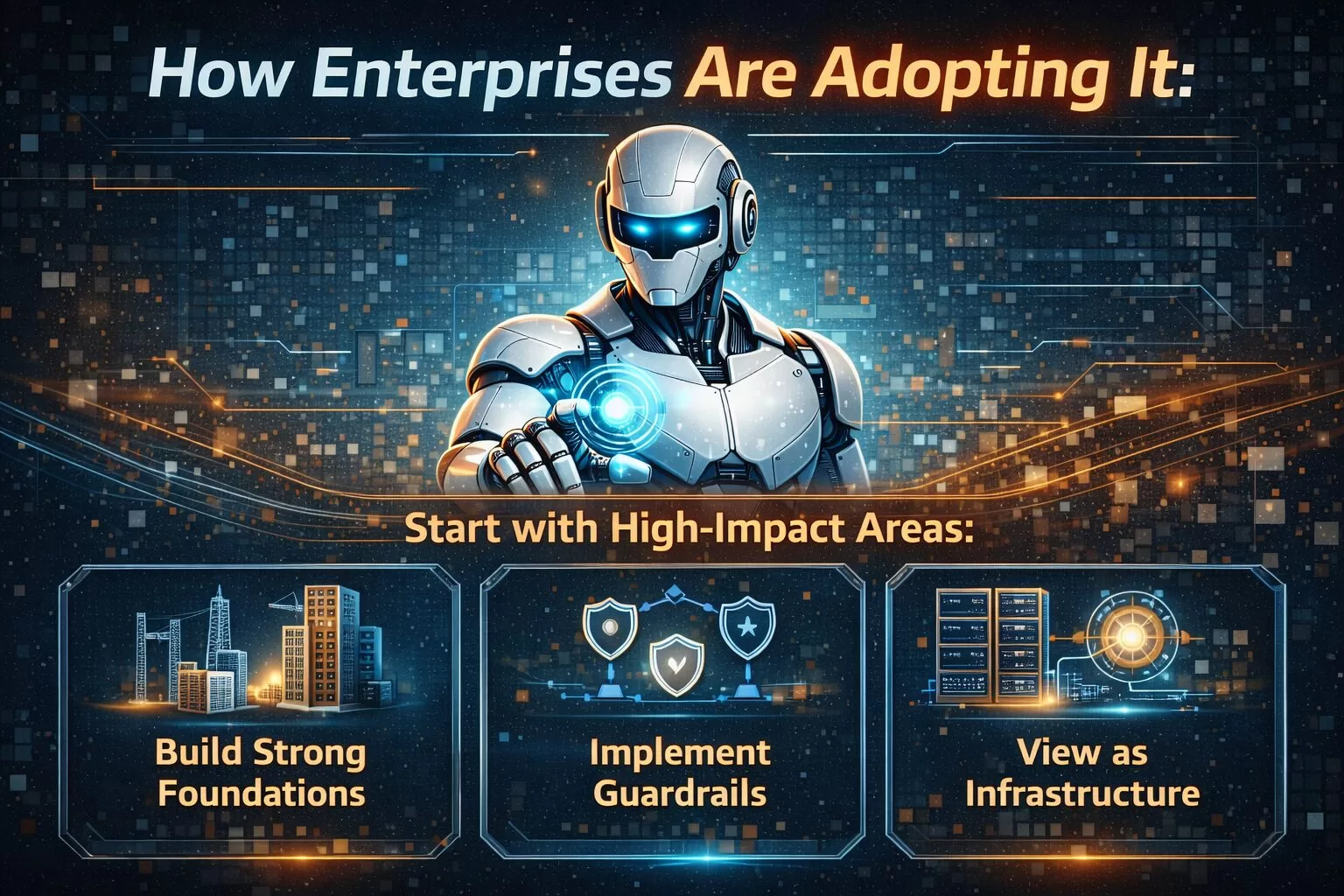
Start with High-Impact Areas: Push through functions like IT, finance, or logistics where quickness and precision are the most important factors.
Build Strong Foundations: Focusing on integration layers that are strong, data that is unified, and governance that is clear is an excellent way of operating.
Implement Guardrails: Define clearly the areas of agent autonomy and oversight that will be in place.
View as Infrastructure: Considering agentic AI as a capability layer that is core to the business and not just a backroom project, for maximum ROI.
By adopting Agentic AI applications, organizations can streamline operations and respond faster to market changes.
Advantages of Agentic AI for Businesses
The use of agentic technology provides a very high-quality return on investment:
Decision-making that is quicker and based on more information
Better operational flexibility and increase in capacity
Less manual operation and fewer mistakes
More uniformity in the different procedure
More resources for innovation and activities with high value
All these benefits have made the utilization of agentic AI applications very rapid in different sectors.
FAQ’s
Agentic AIs are designed to autonomous systems that generate and manage their own goals, while traditional AIs are primarily based on providing predictable responses to predetermined inputs.
Yes. Because of the prevalence of cloud-based services, many small and medium-sized enterprises now have access to agent-based technology.
No. Agentic systems provide supplemental support for humans by performing repetitive and time-consuming complex decision-making tasks.
Security of agentic AIs depends heavily on how they are implemented, governed, and monitored.
Agentic AI applications are systems that act autonomously to automate tasks, enhance decision-making, and improve enterprise efficiency
The Future Is Agentic
Agentic AI denotes a revolutionary change in the development and use of enterprise applications. Autonomy, adaptability, and continuous intelligence are characteristics that come along with agent-based systems. Those organizations that embrace this strategy will be the first ones to have an agile, robust, and future-proof digital ecosystem.
Turn Agentic AI concepts into enterprise-ready skills.
Big Data Trunk’s professionally-oriented training will help you to acquire practical competencies in AI-powered systems, AIOps, and smart applications. Get educated on the agentic AI applications in the technology of tomorrow.