
Introduction
Businesses today don’t struggle with lack of data—they struggle with understanding it. This is where augmented analytics and AI-powered analytics make a real impact.
By combining artificial intelligence, machine learning, and NLP for analytics, organizations can automatically generate insights, detect patterns, and make faster decisions without deep technical expertise. From automated BI insights to self-service dashboards, augmented analytics is transforming how companies use data to stay competitive.
Businesses looking to adopt these technologies can benefit from structured learning through our AI-powered analytics course, designed to build real-world skills in data-driven decision-making.
What is Augmented Analytics? (Definition + Example)
Augmented analytics is the use of AI-powered analytics, machine learning, and NLP to automate data analysis, generate insights, and improve business decision-making without manual effort.
According to Gartner, augmented analytics uses AI and machine learning to automate data preparation, insight generation, and explanation.
Example:
A retail company uses augmented analytics to automatically identify which products are underperforming and why without manual data analysis.
How AI-Powered Analytics Works in Business Intelligence
AI-powered analytics enhances business intelligence by automating the entire data lifecycle:
- Collects data from multiple sources
- Cleans and prepares data automatically
- Uses AI to detect patterns and trends
- Generates predictive insights
- Visualizes results in dashboards
If you’re new to this process, our data analytics program helps you understand data collection, cleaning, and visualization step-by-step.
This allows businesses to shift from reactive reporting to proactive decision-making.
Key Features of Augmented Analytics Tools
- Automated data preparation- Automatically cleans, organizes, and structures raw data from multiple sources. This reduces manual effort and ensures data is ready for analysis quickly.
- AI-driven insight generation- Uses machine learning algorithms to identify trends and generate actionable insights. It helps businesses uncover patterns without requiring deep analytical expertise.
- Predictive analytics capabilities- Analyzes historical data to forecast future trends and outcomes. This enables organizations to make proactive, data-driven decisions.
- Real-time data processing- Processes and analyzes data instantly as it is generated. This allows businesses to respond quickly to changes and emerging opportunities.
- Data visualization tools- Converts complex data into easy-to-understand charts, graphs, and dashboards. This improves clarity and helps stakeholders interpret insights effectively.
- Self-service analytics dashboards- Enables users to explore data and generate reports without technical assistance. It empowers teams to make decisions independently using intuitive interfaces.
Role of NLP for Analytics in Self-Service BI
NLP for analytics allows users to interact with data using simple language.
Instead of writing complex queries, users can ask:
What were the top-performing products last quarter?”
The system processes the query and delivers insights instantly. This enables data democratization, where even non-technical users can explore and analyze data.
To master this skill, explore our NLP for analytics training, where you learn how to build conversational data systems.
Automated BI Insights: How AI Finds Hidden Patterns
Automated BI insights use AI algorithms to continuously scan data and detect:
- Hidden patterns- Identifies relationships and trends in data that are not immediately visible. These insights help businesses discover new opportunities and strategies.
- Anomalies and outliers- Detects unusual data points or deviations from expected patterns. This helps in identifying risks, fraud, or operational issues early.
- Performance changes- Monitors variations in key performance indicators over time. Businesses can quickly react to declines or capitalize on improvements.
- Key business drivers- Highlights the factors that most influence outcomes and performance. This allows organizations to focus on what truly impacts growth.
These insights are delivered in real time, helping organizations make faster and smarter decisions.
Augmented Analytics vs Traditional BI
The table below highlights the key differences between traditional business intelligence and augmented analytics in terms of efficiency, accessibility, and decision-making.
|
Feature |
Traditional BI |
Augmented Analytics |
|---|---|---|
|
Data Analysis |
Manual |
Automated |
|
Insights |
Analyst-driven |
AI-generated |
|
Speed |
Slow |
Real-time |
|
Accessibility |
Limited |
Self-service |
|
Decision-Making |
Reactive |
Proactive |
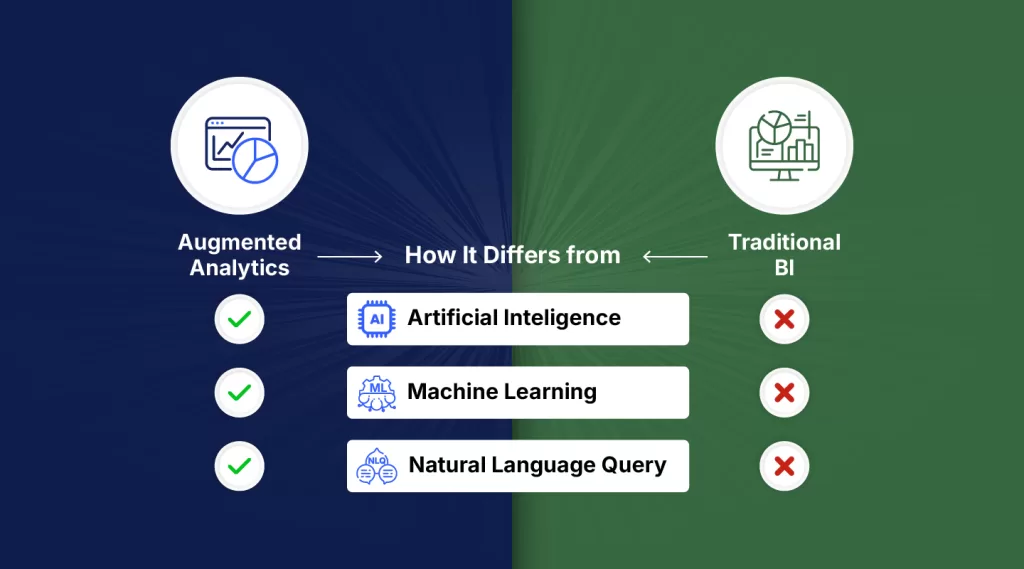
Benefits of Augmented Analytics for Businesses
- Faster Decision-Making – AI automation reduces analysis time significantly.
- Increased Accuracy – Minimizes human errors and improves data reliability.
- Improved Accessibility – Enables non-technical users to analyze data.
- Cost Efficiency- Reduces dependency on large analytics teams.
- Scalability – Handles large datasets with ease.
Studies show that organizations using AI-powered analytics can significantly improve decision-making speed and efficiency.
Top Use Cases of AI-Powered Analytics
- Retail: Demand forecasting and customer insights
- Healthcare: Predictive diagnostics
- Finance: Fraud detection and risk analysis
- Marketing: Campaign optimization and personalization
How to Implement Augmented Analytics (Step-by-Step)
- Define business goals- Clearly identify what you want to achieve with analytics. This ensures alignment between data initiatives and business outcomes.
- Choose the right BI tools– Select tools that support AI-driven analytics and scalability. The right tools improve efficiency and ease of use.
- Integrate data sources- Combine data from multiple systems into a unified platform. This provides a complete and accurate view for analysis.
- Enable NLP-based queries- Allow users to interact with data using natural language. This simplifies access to insights for non-technical users.
- Train teams on analytics tools- Provide training to ensure teams can effectively use analytics platforms. Skilled users maximize the value of the tools.
- Continuously monitor and improve- Regularly evaluate analytics performance and refine processes. Continuous improvement ensures long-term success.
Tools & Technologies for Augmented Analytics
Tools like Microsoft Power BI, Tableau, and Google Looker are widely used in augmented analytics. Platforms from Amazon Web Services (AWS) also provide scalable AI-powered analytics solutions for businesses.
Learn how to use these tools practically with our business intelligence training program, focused on real-world dashboards and analytics implementation.
Learning Roadmap (3–6 Months)
1. Month 1–2: Data analytics fundamentals
Learn basic concepts like data collection, cleaning, and visualization. This builds a strong foundation for advanced analytics.
2. Month 3–4: Machine learning basics
Understand key ML algorithms and how they analyze data. This helps in building predictive models and automation.
3. Month 5–6: NLP for analytics + real-world projects
Explore natural language processing and apply skills in projects. This prepares you for practical, industry-ready analytics roles.
Career Path in AI-Powered Analytics
1. Beginner: Data Analyst
Focuses on data cleaning, visualization, and basic reporting. This role builds foundational skills in analytics.
2. Intermediate: BI Analyst
Works on dashboards, business insights, and reporting tools. This role bridges business needs with data insights.
3. Advanced: AI Analytics Specialist
Develops AI-driven models and advanced analytics solutions. This role focuses on automation and predictive intelligence.
Real-World Project Ideas
- Sales forecasting dashboard- Builds a dashboard to predict future sales trends. This helps businesses plan inventory and revenue strategies.
- Customer churn prediction- Identifies customers likely to leave using behavioral data. This enables proactive retention strategies.
- Fraud detection system- Uses AI models to detect suspicious transactions. This improves financial security and risk management.
- Marketing performance analysis- Evaluates campaign success using data insights. This helps optimize marketing strategies and spending.
Challenges of Augmented Analytics
- Data quality issues- Poor or inconsistent data can lead to inaccurate insights. Ensuring clean data is critical for reliable analytics.
- Integration complexity- Combining multiple data sources can be technically challenging. Proper planning and tools are required for seamless integration.
- Data security concerns- Handling sensitive data increases the risk of breaches. Strong security measures are essential to protect information.
- Initial implementation cost- Setting up analytics infrastructure can be expensive. However, long-term benefits often outweigh the initial investment.
Future Trends in Augmented Analytics (2026 & Beyond)
Industry leaders like Google and IBM are investing heavily in AI-driven analytics to enable real-time and conversational data insights.
Key trends include:
-
Conversational analytics using AI- Users will interact with data through natural language conversations. This makes analytics more intuitive and accessible.
-
Real-time automated insights- AI will deliver instant insights as data is generated. Businesses can make decisions faster than ever before.
-
Deeper AI integration in BI tools- Analytics platforms will embed advanced AI capabilities. This will enhance automation and predictive power.
-
Growth of self-service analytics- More users will independently analyze data without technical support. This democratizes data across organizations.
Conclusion
Augmented analytics and AI-powered analytics are transforming how businesses interact with data. By combining NLP for analytics and automated BI insights, organizations can make faster, smarter, and more accurate decisions. As data continues to grow, adopting augmented analytics is essential for staying competitive in the modern business landscape.
Transform Your Data with Big Data Trunk
Ready to master augmented analytics and build real-world AI-powered analytics solutions?
Explore our data analytics course with placement support and gain hands-on experience in AI, NLP, and business intelligence.
FAQs
1. What is augmented analytics?
Augmented analytics uses AI, machine learning, and NLP to automate data analysis and generate insights, making it easier for businesses to make data-driven decisions.
2. How does AI-powered analytics help businesses?
It identifies patterns, predicts trends, and delivers automated insights, helping organizations make faster and smarter decisions.
NLP allows users to query data using natural language, eliminating the need for complex coding or queries.
4. What are automated BI insights?
These are AI-generated insights that highlight trends and anomalies in data without manual analysis.
5. What tools are used in augmented analytics?
Popular tools include Power BI, Tableau, Looker, and Python-based analytics platforms.
6. What are the benefits of augmented analytics?
It improves speed, accuracy, accessibility, and scalability of data analytics.
7. Is augmented analytics suitable for beginners?
Yes, it enables non-technical users to analyze data using simple interfaces and NLP.
8. What industries use AI-powered analytics?
Finance, healthcare, retail, and marketing widely use AI-powered analytics.