The workplace is entering a new era where digital employees can perform tasks, make decisions, and collaborate alongside humans. This transformation is being driven by the AI Agent Economy, a growing ecosystem powered by AI agents and autonomous AI systems. Unlike traditional software, these intelligent agents can work independently, automate workflows, and improve productivity at scale. As organizations increasingly adopt AI-powered workers, understanding their impact on businesses and the future of work has become more important than ever.
What Is the AI Agent Economy?

The AI Agent Economy is a business ecosystem where AI-powered agents act as digital workers that can perform tasks, make decisions, and collaborate with humans. Unlike traditional automation tools that follow fixed rules, AI agents can understand goals, adapt to changing situations, and execute workflows independently.
These intelligent systems are helping organizations streamline operations, improve efficiency, and scale faster. As AI technology advances, businesses are increasingly integrating AI agents into everyday processes, creating a new model of work where humans and machines operate together.
How AI Agents and Autonomous AI Work?
AI agents are software systems designed to complete specific objectives. They gather information, analyze data, and take actions to achieve defined goals.
Autonomous AI takes this a step further by managing entire workflows with limited human involvement. For example, an autonomous AI customer support agent can answer questions, retrieve information, escalate issues when needed, and update records automatically.
This ability to act independently makes autonomous AI a powerful tool for organizations looking to increase productivity and improve decision-making.
Traditional Automation vs AI Agents
| Feature | Traditional Automation | AI Agents |
| Decision Making | Rule-based | Context-aware |
| Learning Ability | No | Yes |
| Adaptability | Limited | High |
| Human Supervision | High | Low |
| Workflow Complexity | Basic | Advanced |
The ability to learn, adapt, and make decisions distinguishes AI agents from conventional automation systems.
Why the AI Agent Economy Is Growing?
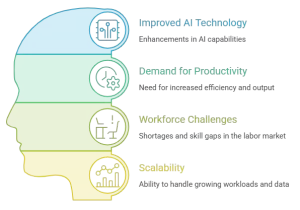
Several factors are accelerating the adoption of AI agents:
Improved AI Technology
Advances in machine learning, large language models, and agentic AI have made intelligent systems more capable and reliable.
Demand for Productivity
Organizations are under pressure to improve efficiency. AI agents can work continuously and process information faster than manual workflows.
Workforce Challenges
Labor shortages and skill gaps are encouraging businesses to use digital workers to support existing teams.
Scalability
AI agents can be deployed across multiple functions without the limitations associated with hiring and training large teams.
Key Benefits of AI Agents for Businesses
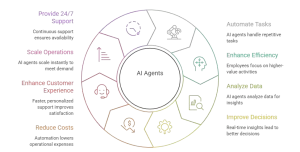
Organizations adopting AI agents can gain several advantages:
- Increased Productivity: AI agents automate repetitive tasks, allowing employees to focus on higher-value activities.
- Faster Decision-Making: They analyze large volumes of data quickly and provide actionable insights in real time.
- Reduced Operational Costs: Automating routine processes helps lower labor costs and improve resource utilization.
- Improved Customer Experiences: AI agents deliver faster responses and personalized support around the clock.
- Better Scalability: Businesses can deploy additional AI agents instantly to handle growing workloads.
- 24/7 Operational Support: Unlike human employees, AI agents can work continuously without breaks or downtime.
- Enhanced Workforce Efficiency: AI-powered systems streamline workflows and enable teams to accomplish more in less time.
These benefits are making AI-powered employees a strategic asset across industries.
Will AI Agents Replace Human Employees?
One of the biggest concerns surrounding the AI Agent Economy is whether AI will replace human workers. While AI agents may automate repetitive tasks, they are more likely to augment human capabilities than eliminate jobs entirely.
AI systems excel at handling administrative and data-intensive activities such as scheduling, reporting, customer support, and document processing. Human employees, however, continue to provide creativity, emotional intelligence, leadership, and strategic thinking.
The future workplace will likely consist of hybrid teams where humans and AI agents collaborate to achieve better outcomes.
AI Agent Economy Examples Across Industries
The AI Agent Economy is already reshaping multiple sectors.
Healthcare
AI agents assist with patient scheduling, documentation, and administrative workflows.
Financial Services
Banks use AI agents for fraud detection, compliance monitoring, and customer support.
Retail and E-Commerce
Retailers leverage autonomous AI for inventory management, demand forecasting, and personalized recommendations.
Human Resources
AI-powered agents help with resume screening, interview scheduling, and employee onboarding.
Manufacturing and Logistics
Organizations use AI agents to optimize supply chains, predict maintenance requirements, and improve operational efficiency.
These examples demonstrate how AI agents are becoming valuable members of the digital workforce.
Skills Needed in the AI Agent Economy
As AI adoption grows, professionals should focus on developing:
- AI Literacy: Understanding how AI works, its capabilities, and its limitations to use it effectively in the workplace.
- Prompt Engineering: Creating clear and effective instructions that help AI systems generate accurate and useful responses.
- Workflow Automation: Using AI tools to streamline repetitive processes and improve operational efficiency.
- Data Analysis: Interpreting data and extracting insights to support informed business decisions.
- Critical Thinking: Evaluating AI-generated outputs and making sound judgments based on context and objectives.
- AI Governance Knowledge: Understanding ethical, legal, and compliance considerations related to AI deployment.
- Human-AI Collaboration Skills: Working effectively with AI systems to combine human expertise with machine efficiency.
These capabilities will help individuals remain competitive in the evolving job market.
The Future of Work in an AI Agent Economy
The future of work will be defined by collaboration between humans and intelligent systems. Rather than replacing employees entirely, AI agents will help organizations automate routine processes while enabling people to focus on innovation, strategy, and relationship-building.
If you want to stay ahead in the future of work, building practical skills is essential. At Big Data Trunk, you can explore industry-focused programs designed to help you master AI, automation, and data skills needed for modern digital roles.